












What is AI search optimisation?
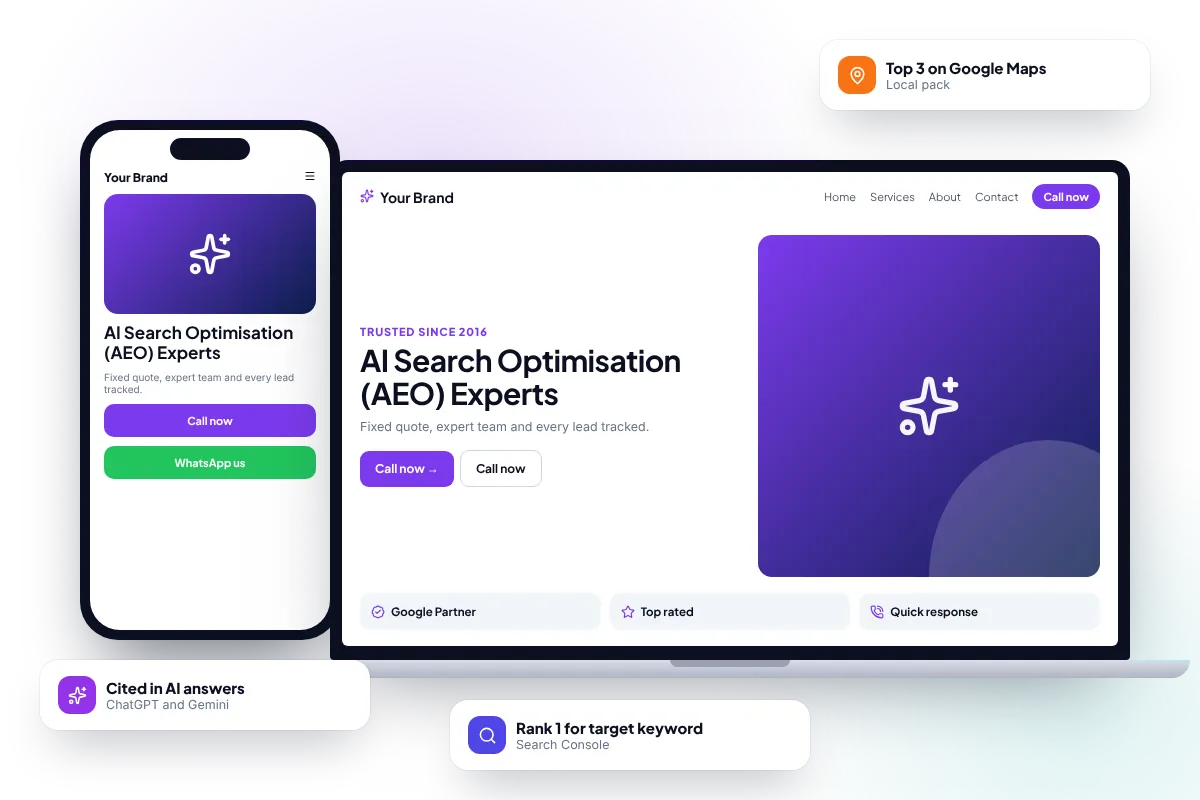
AI search optimisation (also called AEO or GEO) improves how AI assistants understand and recommend your business, using clear content, structured data and trusted third-party mentions.
AI assistants build answers from sources they trust: well-structured websites, review platforms, directories, lists and discussions. If your business is missing from those sources, AI will recommend competitors.
Popular searches we help with: Top Google Business Profile Optimization Company and Top GMB Optimization Company.
How we improve AI visibility
Answer-first content, complete structured data, consistent business information, reviews and mentions on the platforms AI tools use.
- Test how AI assistants currently describe and rank you
- Rewrite key pages with direct, quotable answers
- Complete Organization, Service and FAQ schema
- Build mentions on review sites, directories and industry lists
- Track AI mentions month by month
Who is ai search optimisation (aeo) for?
- Service businesses whose buyers research with AI
- B2B companies on procurement shortlists
- Clinics and professionals
- Brands losing traffic to AI answers
In short
AI search optimisation makes your business easier for ChatGPT, Gemini, Claude, Perplexity and Google AI Overviews to find, trust and cite. We add direct answers and FAQs to key pages, structured data, an llms.txt file and consistent profiles and mentions across the web, then test buyer questions in AI tools every month to track whether you are mentioned.
Types of AI search optimisation (AEO)
There is no single kind of AI search optimisation (AEO). The right option depends on your goals, budget and how your customers buy.
| Option | Best for |
|---|---|
| Entity and brand optimisation | Making AI tools understand who you are |
| Answer-first content | Being quoted for buyer questions |
| Schema and structured data | Machine-readable business data |
| Citations and mentions | Being referenced on trusted sites |
| AI visibility monitoring | Tracking where AI tools mention you |
What a good AI search optimisation (AEO) project includes
A good AI search optimisation (AEO) project covers more than delivery. These are the parts that decide whether it pays for itself.
- Answer-first page structure
- Complete organisation and service schema
- llms.txt and AI crawler access
- Consistent business details across the web
- FAQ content around real questions
- Listings on review and directory sites
- Bing and Google indexing
- Monthly AI visibility checks
Buyers now ask AI before they search
More and more buyers ask ChatGPT, Gemini, Claude, Perplexity or Google AI Overviews for recommendations, such as "best website development company in Bangalore" or "how much does an app cost in India". These tools answer with a few names and sources. AI search optimisation, also called answer engine optimisation or AEO, makes your business one of the names and sources they choose.
How AI tools choose what to cite
AI answers draw on content that is clear, factual, well structured and consistent across the web. They favour pages that answer a question directly, explain details in plain language and come from sources that appear trustworthy: businesses with reviews, mentions on other sites, consistent details and expert content.
How much does AI search optimisation (AEO) cost?
The cost of AI search optimisation (AEO) depends on scope, not on a fixed package. After a short call we recommend exactly what your business needs.
- Website size: pages to restructure
- Content: new answer-focused content
- Citations: listings and mentions
- Competition: how often competitors are cited
- Monitoring: regular checks across AI tools
To get an accurate quote, share what you want to achieve, any examples you like, and your timeline. You get scope, price and dates in writing before any work starts.
Common AI search optimisation (AEO) mistakes to avoid
Most AI search optimisation (AEO) problems come from a few avoidable mistakes. Here is what we see most often, and how to avoid it.
- Blocking AI crawlers. check robots.txt
- Vague content. AI tools quote clear answers
- Inconsistent business details. confuses AI and search engines
- Ignoring Bing. ChatGPT search relies on it
- No third-party mentions. AI tools trust what others say about you
AI Search Optimisation (AEO): key terms explained
Short, plain-English definitions of terms you will hear during an AI search optimisation (AEO) project.
- AEO
- answer engine optimisation
- AI Overview
- Google’s AI-generated answer at the top of search
- Entity
- a clearly defined thing, such as your business
- llms.txt
- a plain summary file for AI tools
What we do
- Rewrite key pages with direct answers at the top of each section
- Add FAQ, service, organisation and product schema
- Publish an llms.txt file describing your business and key pages
- Build consistent profiles and mentions on directories, review sites and industry platforms
- Create comparison and pricing guides that AI tools quote
- Make sure AI crawlers can access your site
Measuring AI visibility
We test a set of buyer questions across major AI tools every month and record whether your business is mentioned or cited, alongside Google AI Overview appearances.
Works together with SEO
AI search optimisation builds on good SEO. The same clear content and authority help you rank in Google and be cited by AI tools.
An early advantage
Few businesses are optimising for AI search yet. Starting now builds the presence that AI tools learn from as they grow.
How we test your AI visibility
We prepare a list of questions your buyers might ask AI tools, such as best providers in your city, costs, comparisons and how-to questions. Each month we ask them in ChatGPT, Gemini, Claude, Perplexity and Google AI Overviews and record whether you are mentioned, cited or missing, and who appears instead. This shows where content or mentions need strengthening.
Content AI tools like to cite
Clear definitions, cost ranges with factors, step-by-step processes, comparisons and FAQs written in plain language are the formats most often cited by AI tools.